The Hidden Architecture of a Story
Readers rarely finish a novel thinking about structure. They don’t close a book and immediately analyze motifs, subplots, or thematic cohesion, unless they are an English major. Instead, they remember how the story made them feel. They remember the heartbreak, the tension, the hope, the satisfaction of a perfectly timed revelation, or the ache of a bittersweet ending.
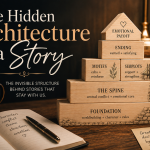 But beneath every emotionally satisfying story is something almost invisible: story architecture.
Just like a house needs beams, support walls, and a foundation strong enough to hold everything together, stories need internal structure capable of carrying emotional weight. Without it, even beautiful writing can feel disconnected or unfinished. With it, stories become immersive, memorable, and emotionally resonant.
The good news? Story architecture doesn’t have to feel rigid or mechanical. In fact, when it’s working well, readers barely notice it at all.
Many professional writers and editors, including contributors at Writer’s Digest, emphasize that structure is often what transforms a compelling idea into a memorable story.
Why Every Story Needs a Spine
At the center of every strong story is a spine: the core emotional or narrative thread that holds everything together.
 This spine is more than just “the plot.” It’s the driving force underneath the story. It might be:
- a character searching for belonging
- a need for redemption
- the fear of losing someone
- the struggle to discover identity
- the pursuit of justice or revenge
The spine gives your story direction. It creates cohesion between scenes, relationships, and character choices.
Writers sometimes create beautiful moments that don’t actually support the spine of the story. A scene may be entertaining, emotional, or even brilliantly written, but if it doesn’t connect back to the central narrative or emotional journey, it can weaken the structure instead of strengthening it.
I have an entire graveyard of scenes I loved that no longer fit the story. I call them outtakes. If you’re deeply attached to a scene that doesn’t support your story’s spine, don’t panic-delete it. Save it. Think of it as the DVD bonus feature section of your writing life.
A powerful story doesn’t require every scene to be dramatic. It requires every scene to matter.
Think of the spine as the answer to this question:
What emotional or narrative force is carrying this story forward?
Once you know that answer, decision-making becomes much easier. Scenes, dialogue, and even subplots can be evaluated based on whether they support or distract from that central structure.
The Secret Purpose of Subplots
Subplots often get misunderstood. Some writers treat them like optional side quests, while others accidentally let them overpower the main story entirely. In reality, strong subplots act like support beams within story architecture. A good subplot should strengthen the emotional impact of the main narrative, not pull readers away from it. The best subplots:
- reinforce the story’s themes
- create contrast or mirrors for the protagonist’s journey
- deepen important relationships
- add pacing variety
- increase emotional stakes
For example, a romance subplot may reflect a character’s deeper fear of vulnerability. A friendship subplot may highlight the protagonist’s struggle with trust. A family conflict may mirror the larger theme of identity or belonging. Strong subplots don’t distract from the main story. They strengthen it from underneath. One of the easiest ways to tell whether a subplot is working is to ask yourself this:
If I removed this subplot entirely, would the emotional impact of the story weaken?
If the answer is yes, the subplot is probably serving its purpose beautifully. If the answer is no, it may need stronger thematic ties to the spine of the story.
Need more support for your current project? Visit my Writing Resources page for tools, worksheets, and creative prompts to help strengthen your story.
Using Motifs Without Being Heavy-Handed
Motifs are one of the quietest tools in story architecture, but they can create incredible emotional resonance when used well. A motif is a recurring image, symbol, phrase, object, sound, or idea that gains emotional meaning through repetition.
The key word here is repetition.
Writers often worry about symbolism feeling forced, and honestly, that fear is valid. Readers can absolutely sense when a story is trying too hard to appear “deep.” Heavy-handed symbolism usually pulls readers out of the experience instead of drawing them deeper into it.
The best motifs feel natural.
They appear quietly in the background and gradually gather emotional weight over time. Readers may not consciously notice them at first, but they feel the pattern developing underneath the surface.
Motifs can take many forms:
- storms appearing before emotional conflict
- mirrors connected to identity struggles
- recurring songs tied to memory
- seasonal imagery reflecting emotional change
- repeated phrases that evolve in meaning over time
Motifs work best when readers feel them before they consciously notice them. That subtle emotional layering is part of what makes certain stories linger in readers’ minds long after the final page.
The Architecture of a Satisfying Ending
A satisfying ending doesn’t necessarily mean a happy ending. It means an earned ending.
Readers invest emotional energy into stories. They follow characters through conflict, growth, fear, hope, and transformation. A strong ending rewards that investment by creating emotional and structural payoff. This is where story architecture matters most.
A satisfying ending often:
- resolves the central emotional question
- reconnects to the spine of the story
- pays off earlier setups and motifs
- brings subplots to meaningful resolution
- reflects character growth
- creates thematic closure
Readers may forgive a slow beginning, but they rarely forgive an ending that feels disconnected from the story they invested in. Some endings surprise readers. Others devastate them. Others leave them hopeful or reflective. But the endings that truly stay with people usually feel inevitable in hindsight. Not predictable. Inevitable.
 That feeling comes from careful structural groundwork laid throughout the story.
It’s also worth saying that I don’t consciously think about most of these things while writing a first draft. When I’m drafting, I’m usually fully immersed in the story itself: the characters, the dialogue, the emotion, and whatever chaos my brain has decided to unleash that day.
It’s only later, when I go back to reread and edit, that I start noticing the hidden architecture underneath the story. Sometimes I discover I’ve subconsciously planted motifs or emotional parallels without even realizing it. Other times, I can clearly see where the structure needs reinforcement, where a subplot is drifting too far from the spine, or where an ending needs stronger emotional payoff.
That’s one of the beautiful things about revision. It gives writers the chance to strengthen the invisible framework supporting the story while still preserving the emotional heart that made them want to write it in the first place.
Final Thoughts on Story Architecture
Great stories rarely succeed by accident.
Beneath every unforgettable emotional moment is structure quietly doing its job. The strongest stories are built with intention, even when readers never consciously notice the framework underneath.
Understanding story architecture doesn’t limit creativity. It strengthens it. When writers understand the hidden structure supporting their work, they gain the ability to create stories that feel cohesive, immersive, and emotionally satisfying.
If you’re working on a novel or short story right now, take a step back and examine the architecture underneath it. Look at the spine holding it together, the subplots supporting it, the motifs echoing through it, and the emotional payoff waiting at the end.
Sometimes the difference between a good story and an unforgettable one isn’t the idea itself.
It’s the structure quietly holding everything together.
If you’d like more writing tools, story resources, and creative inspiration, explore my Writing Resources page for additional support and ideas for your next project.