Plotting Without Losing Your Mind
Plotting without losing your mind sounds like a joke until you are staring at a blank outline template, wondering why it suddenly feels like you have been asked to assemble IKEA furniture using only emotional damage and vibes.
 You know the feeling. The spreadsheets. The beat sheets. The color-coded chapter trackers. The advice that insists you should already know every plot point before you write Chapter One.
And somewhere along the way, a lot of writers quietly start believing this means they are bad at plotting. But I do not think most writers hate structure. I think they hate structure that suffocates them.
Because some of us do not discover stories in neat little boxes. Some of us discover stories through emotional moments, character chemistry, aesthetic images, snippets of dialogue, themes, vibes, scenes that arrive before context, and endings that feel emotionally true long before they make logical sense.
And yet the writing world often treats structure like an all-or-nothing choice.
Either you are a hyper-organized plotter with seventeen tabs open and a murder board on your wall, or you are a chaotic goblin throwing words into the void and hoping a novel appears – that would be me in case anybody was interested.
But there is a middle ground nobody talks about enough. A way that allows plotting without losing your mind.
A softer kind of structure. One built on breadcrumbs instead of blueprints. That is what this series is about.
While I love to write, I am a teacher at heart.
That means my brain has a tendency to wander off into “how can I help people understand this better?” territory when I should probably just be writing my own books.
Somewhere along the way, I started noticing patterns in the way intuitive writers approach story structure. The breadcrumbs we leave ourselves. The emotional landmarks we follow. The half-organized systems that somehow make perfect sense to us and absolutely nobody else.
And before I knew what happened, one brainstorming session had quietly turned into an entire series. Because maybe the problem is not that some writers are bad at plotting. Maybe they have just been trying to use systems built for a different kind of creative brain.
Why Traditional Outlining Fails Some Writers
Traditional outlining works beautifully for some writers. This is not an anti-outline rebellion with pitchforks and flaming Scrivener templates. But rigid outlining can become a problem when the outline starts feeling more alive than the story  itself.
It can become a problem when creativity gets replaced with obligation, every scene feels predetermined, and writing starts to feel like homework instead of discovery. A lot of intuitive writers do not actually need more control. They need more clarity. There is a difference.
Clarity says, “Here is the next meaningful step.”
Control says, “You must know everything immediately.”
Those are not the same thing.
There are plenty of excellent story structure models out there, and understanding them can be genuinely helpful. Reedsy has a useful guide to different types of story structure if you want to compare traditional approaches. The trick is not forcing yourself into a system that makes your creative brain slam the laptop shut and wander off to reorganize a junk drawer. Remember the goal is plotting without losing your mind!
Structure Without Rigidity
Over time, I started realizing I naturally used a completely different kind of plotting system. Not rigid plotting. Not total  chaos either. More like gentle navigation.
Instead of outlining every chapter, I would collect emotional turning points, vivid images, relationship shifts, moments of tension, and scenes that felt inevitable. I was not building a blueprint. I was building constellations.
And eventually I realized something important:
Stories do not always need a full map. Sometimes they just need landmarks.
That realization completely changed the way I approached plotting.
The Middle Ground Between Plotting and Pantsing
Some writers love detailed outlines. Some writers would rather wrestle a raccoon in a cardigan than plan their story scene by scene. Most of us are somewhere in the middle.
We want direction, but we also want discovery. We want to know where the story is going, but we do not want to drain all the magic out of it before we even begin. That is where gentle structure comes in. Gentle structure gives you enough of a path to keep moving, but not so much that the story feels trapped. It helps you meet the goal of plotting without losing your mind!
It lets you work with:
- emotional breadcrumbs
- major story anchors
- scene seeds
- character wants and fears
- relationship shifts
- visual moments
- themes and tone
In other words, it lets you build a story from the inside out.
What You Will Find in This Series
Over the next few posts, we are going to explore several low-pressure plotting methods designed for writers who want direction without creative suffocation.
The Breadcrumb Method
This is a way to discover your ending by following emotional, visual, and story breadcrumbs instead of forcing a rigid outline. You do not need to know the whole path. You only need the next meaningful marker.
The Five Anchors Method
This method gives your story five major landmarks: the opening situation, the inciting incident, the midpoint shift, the dark moment, and the ending vibe. Not the entire ending. Just the feeling of it. See? We are being reasonable here.
Scene Seeds
Scene seeds help you plan only the next few scenes instead of trying to map the entire book at once. Each scene seed focuses on a goal, an obstacle, and a shift.
The Three-Scene Fix
This is a practical way to diagnose broken plots, sagging momentum, and wandering storylines without convincing yourself you need to rewrite the entire manuscript and possibly move to the woods.
Why Middle Acts Sag
Middle acts are where many good stories go to nap. We will look at why that happens and how to bring the middle of your story back to life without panic, bonfires, or dramatic declarations that writing is impossible.
A Free Resource for Writers Who Like Gentle Structure
If this kind of approach sounds like your writing brain’s cup of tea, I have a growing collection of free tools for writers available here: 29 Free Writing Resources.
You can download resources as needed, whenever they fit what you are working on. Or, if you want the complete guide and reminders when new writing thingys are added, you can sign up for my mailing list and get everything in one cozy little bundle of “thank goodness, I needed that.” And yes, I said thingys!
No pressure. No spammy weirdness. Just helpful writing tools when your creative brain needs a little support and maybe a snack.
You Are Not Doing Writing Wrong
I think a lot of writers have spent years believing they were failing because traditional plotting systems did not fit the way their brains naturally create stories. But writing is not one-size-fits-all. Some writers build cathedrals brick by brick. Some writers follow lantern light through the woods.
Both still arrive at stories.
 The goal here is not perfect structure. The goal is plotting without losing your mind. I cannot stress that enough. It is not productivity culture. It is not squeezing creativity into corporate spreadsheets. The goal is momentum, emotional clarity, flexibility, confidence, and finishing stories without losing the joy of writing them.
Because stories are not machines. They are living things. And sometimes living things grow best when given guidance instead of control.
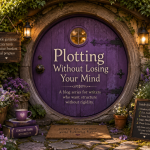
So if you have ever felt trapped somewhere between plotting and pantsing, pull up a chair. The tea is warm. The purple hobbit door is open. And you only need the next breadcrumb.