The Rhythm of Sentences: How Prose Affects Mood
Have you ever read an action scene that somehow felt…slow? The character is running for their life. Someone is chasing 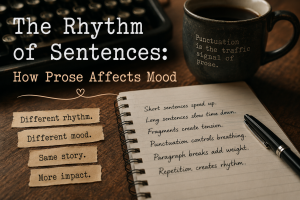 them. Things are exploding. The author has included all the appropriate chaos.
And yet you’re reading it like you’re waiting in line at the DMV.
Or maybe you’ve had the opposite experience. You’re reading what should be a quiet, emotional moment, but the sentences are so short and abrupt that you feel like someone is repeatedly poking you in the forehead.
That’s because sentence rhythm affects mood. Mood doesn’t come only from what happens in a scene. It also comes from the rhythm of the words you use to tell it. Sentence length, punctuation, paragraph breaks, repetition, and even where you choose to stop a sentence can change the way a reader experiences a scene.
Your prose has a heartbeat. Sometimes, changing that heartbeat is all you need to change the mood.
Readers Feel Sentence Rhythm Even When They Don’t Notice It
Most readers aren’t consciously analyzing sentence structure while they read. They aren’t thinking, Ah yes. An excellent use of a compound-complex sentence to create a contemplative atmosphere. At least, I hope they aren’t.
They’re simply experiencing the story. But their brains are responding to the rhythm of your sentences.
- Short sentences move quickly.
- Longer sentences slow things down.
- Fragments interrupt the flow.
- Repeated structures create patterns.
- Paragraph breaks create pauses.
- Punctuation controls when the reader stops, hesitates, or keeps moving.
All of those tiny choices affect how quickly the reader moves through the page—and therefore how the scene feels.
Short Sentences Create Speed and Tension
When things get dangerous, frightening, chaotic, or urgent, shorter sentences can increase the pace.
Consider:
She heard footsteps behind her. She ran faster. They followed. Closer now.
There isn’t much room to breathe. That’s the point. The sentences push the reader forward almost as quickly as the character is moving.
 Compare that with:
She heard footsteps behind her, and although she tried to convince herself that they belonged to someone simply walking in the same direction, their increasingly rapid pace made it impossible to believe.
The information isn’t necessarily wrong. But if she’s currently being chased by a homicidal maniac, this might not be the ideal moment for her prose to take a leisurely stroll through the neighborhood.
Shorter sentences can create urgency, fear, anger, shock, excitement, and confusion. But there’s a catch: if every sentence is short, none of them feel particularly fast. Eventually, the rhythm becomes monotonous.
Contrast Creates Impact
Sentence rhythm works best when it changes. Imagine a scene written primarily with longer, flowing sentences. The reader settles into that rhythm.
Then:
The door opened.
That short sentence suddenly matters. Not because there’s anything particularly complicated about the words, but because the rhythm changed. The reader notices. Something happened.
The same technique works in reverse. After a rapid series of short sentences, a longer sentence can signal that the immediate danger has passed—or give the reader a moment to process what just happened. Good prose doesn’t choose between short sentences and long sentences. It uses both.
Long Sentences Can Slow Time
Longer sentences give readers time to linger. They’re particularly useful when a character is remembering, observing, grieving, falling in love, reflecting, experiencing wonder, or processing something emotionally complicated.
 Imagine a character returning to their childhood home:
The house looked smaller than she remembered, although the porch still sagged in exactly the same place and the old maple still stretched over the roof, its branches brushing against the upstairs window where she had once sat during thunderstorms and convinced herself that nothing bad could ever happen as long as she stayed inside.
The sentence wanders because memory wanders. One observation leads naturally into another, and the reader isn’t being rushed. That slower movement becomes part of the mood.
Fragments Are Tiny Little Weapons
Your English teacher may have told you sentence fragments are wrong. Your English teacher was trying to keep thirty teenagers from turning in essays that said things like:
Because George Washington.
Fiction has different rules. Fragments can be incredibly effective when used deliberately.
Something moved behind her. She turned. Nothing.
That final fragment works because it breaks the expected rhythm. Fragments can mimic thought, shock, fear, realization, or hesitation. But—like every other technique in writing—they lose their power when they’re everywhere.
A fragment should feel intentional, not like punctuation wandered away from the sentence when nobody was looking.
Punctuation Controls Breathing
Commas, periods, semicolons, em dashes, and ellipses aren’t just grammar marks. They’re traffic signals.
- A period says: Stop.
- A comma says: Keep going, but slow down a little.
- An em dash says: WAIT—something just happened.
- An ellipsis says: Something isn’t being said…
 Okay, punctuation probably shouldn’t have this much personality. But it does.
Read your sentences aloud and you’ll hear it. Punctuation determines where your reader breathes, and breathing affects tension. A paragraph filled with commas and flowing sentences can feel dreamy or reflective, while a paragraph full of periods can feel tense and controlled.
You’re not just punctuating sentences. You’re directing the reader’s experience of them.
Paragraph Breaks Matter Too
Sometimes the most powerful rhythm on the page isn’t created by a sentence. It’s created by white space.
She opened the letter and read the first line. Then she read it again. Her father was alive.
Putting that final sentence in its own paragraph gives it weight. The reader pauses before reaching it, then pauses again afterward. If all three sentences were buried inside one larger paragraph, the information would still be there—but it wouldn’t land the same way.
White space creates silence, and silence can be incredibly loud.
Repetition Creates Rhythm
Humans respond naturally to patterns. That’s why repetition can create such strong emotional effects.
She had waited for him yesterday. She had waited for him this morning. She was still waiting.
The repeated structure creates expectation, then the final sentence changes the pattern. That change gives it emphasis. Repetition can create dread, longing, determination, grief, obsession, or anticipation.
Again, moderation matters. You want deliberate rhythm, not a toddler repeatedly asking why? from the back seat for forty-seven consecutive miles.
Try the Read-Aloud Test
One of the easiest ways to find rhythm problems is also painfully simple: read your scene aloud. Yes, really.
You’ll hear things your eyes skip over. You’ll notice when every sentence is approximately the same length, when you’re  running out of breath, when a supposedly frantic scene feels sluggish, when dialogue sounds unnaturally formal, or when the same sentence structure appears repeatedly.
This idea of listening to prose isn’t just a fiction-writing trick. Purdue University’s Online Writing Lab recommends varying sentence structure and length to create rhythm and emphasis. You can read more in its guide to sentence variety.
You don’t have to perform a dramatic audiobook rendition for your household—although you absolutely can. Just listen to the cadence. If your mouth keeps tripping over a sentence, there’s a decent chance your reader’s brain will stumble over it too.
Match the Rhythm to the Emotion
When revising a scene, don’t just ask, What mood am I trying to create? Ask, Does the rhythm of my prose create that mood?
If the scene should feel frantic, look for places where long sentences are slowing things down. If the scene should feel intimate, make sure the prose gives readers enough room to stay inside the moment. If something shocking happens, consider whether a sudden short sentence or paragraph break could make it land harder. If a character is overwhelmed, perhaps the sentence itself should become slightly overwhelming.
Your prose doesn’t simply describe the emotional experience. Your prose can become part of the emotional experience.
Your Story Has a Pulse
Writing isn’t only about choosing the right words. It’s about deciding how those words move: fast, slow, flowing, abrupt, breathless, quiet.
If you’re working on the larger emotional atmosphere of a scene, you may also want to explore Atmosphere & Mood: Giving Your Story a Vibe and The Emotional Weather Technique for Mood.
Sometimes the best way to improve the mood of a scene isn’t adding another description of the weather or explaining how your character feels. Sometimes you just need to listen to the sentences.
Because every story has a rhythm, and when the rhythm matches the emotion, readers don’t just understand the mood you’re trying to create. They feel it.