I use AI
I use AI.
There. I said it. And apparently, in some corners of the writing community, those three words are enough to make people reach for the pitchforks. But here’s the thing: ethical AI use is not the same thing as handing your creative work over to a machine. AI doesn’t 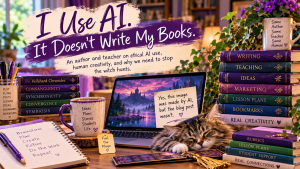 write my books. I do.
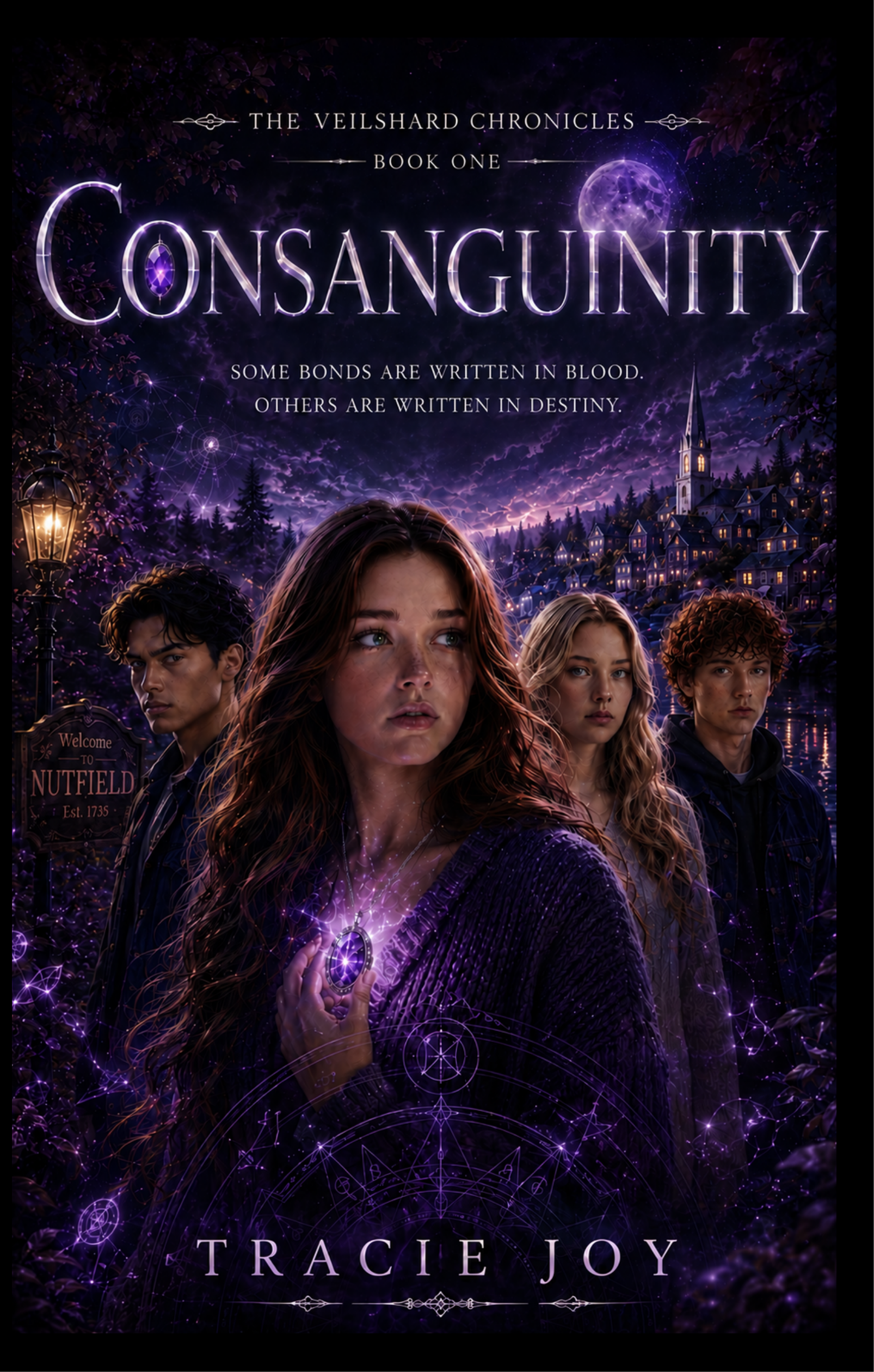
Every character, every relationship, every plot twist, every bit of dialogue, and every terrible thing I do to my readers in Chapter 37? That’s me. I dreamed up the world of The Veilshard Chronicles. I created Aisling, J.T., Eric, and Sabina. I decide what happens to them, what they say, whom they love, what they fear, and what waits for them on the other side of the veil.
Those stories are mine.
But writing the story is only one part of being an indie author.
Apparently, I Have 4,782 Other Jobs
When I decided to independently publish Consanguinity, I knew I’d have to do more than write a book. I’m not entirely sure I understood exactly how much more.
An indie author is also a publisher, marketer, social media manager, website administrator, SEO specialist, advertising department, event planner, publicist, newsletter writer, salesperson, and occasionally a person staring at WordPress at 10:30 at night wondering why something moved three pixels to the left for absolutely no reason. If you’ve ever wondered why supporting indie authors matters, I wrote more about that in Why You Should Support Indie Authors.
And today, apparently, I became a bookmark manufacturer.
I have neither the time nor the money to hire a professional for every single one of those jobs. So yes. I use AI.
 I use it to brainstorm marketing ideas. I use it to help me understand SEO. I use it when WordPress decides to test the limits of my emotional stability. I use it to plan social media posts, organize projects, think through advertising options, work on promotional materials, and figure out what I need for author events. I’ve even used it while developing projects like my Traveling Consanguinity project, where copies of my book are being released into the wild for readers to find.
Sometimes I use AI to help create graphics for a blog post because, while I happily paid a professional artist to create my book cover, I cannot afford to commission an artist every time I want to post something on my website or Instagram.
Today I used AI to help figure out how to make bookmarks for an upcoming author signing. My original plan involved printing the designs on stickers, attaching those stickers to bookmark-shaped cardstock, laminating everything, cutting them out, punching holes in them, and adding tassels.
AI helped me realize that this was an absolutely ridiculous way to manufacture one hundred bookmarks. It did not write a novel. It potentially saved me from spending an entire weekend swearing at a laminator.
There is a difference.
I’m Also a Teacher Who Uses AI
I’m not only an author. I’m also a high school teacher. And yes, I use AI there, too.
I might use it to help refine a lesson plan. I might use it to create or revise a rubric. I can use it to help me think about how to modify an activity for students with different learning needs, brainstorm a new approach when a lesson isn’t working, or take something I’ve  already created and make it clearer.
But AI isn’t teaching my students. I am.
AI doesn’t know the kids sitting in front of me. It doesn’t see the student whose face tells me I’ve lost them even though they haven’t raised their hand. It doesn’t know when my carefully planned lesson needs to be thrown out because this particular class needs something completely different today. It doesn’t build relationships with my students, challenge them, encourage them, redirect them, or celebrate with them when something finally clicks.
That’s my job.
More importantly, I’m teaching my students how to use AI, too. Because pretending AI doesn’t exist isn’t going to prepare them for the world they’re entering.
They need to learn that asking AI to do their assignment for them is not the same thing as using AI to help them understand something. They need to know the difference between asking for feedback and asking for an answer. They need to learn to question what AI gives them, verify information, recognize when it’s wrong, and understand that a confident answer isn’t necessarily a correct one. They also need to understand when using AI crosses the line from assistance into academic dishonesty.
Simply telling students, “AI is bad. Don’t use it,” doesn’t teach any of that.
This isn’t just my personal approach to the issue. UNESCO’s guidance on generative AI in education and research advocates a human-centered approach that protects human agency while exploring meaningful uses of AI in teaching and learning. The U.S. Department of Education has also examined AI’s role in the future of teaching and learning, including both its potential benefits and the risks educators need to consider.
The technology is already here. My students are going to encounter it in college, in the workplace, and in their everyday lives. I’d rather teach them how to use it critically, responsibly, and ethically than send them into that world believing there are only two choices: never touch AI or let it do their thinking for them.
There is an enormous amount of territory between those two extremes. That’s where education belongs.
“Uses AI” Doesn’t Tell You Very Much
That’s the part of this conversation I think we’re losing. When someone says an author “uses AI,” what does that actually mean?
Did they type a prompt into a chatbot and publish whatever came out as a novel? Did they ask it for ten ideas for an Instagram post?  Did they use an AI-powered grammar checker? Did they ask for help understanding their Amazon advertising dashboard? Did they create a promotional image? Did they brainstorm newsletter subject lines? Did they use it to organize research? Did they ask why their website suddenly looks possessed?
Those are wildly different activities, but increasingly they’re being treated as though they’re interchangeable.
They’re not.
Even the U.S. Copyright Office’s work on copyright and artificial intelligence recognizes that distinction. Its report on AI and copyrightability specifically distinguishes using AI tools to assist human creativity from allowing AI to stand in for human creativity. Human authorship matters. So does what the technology is actually being used to do.
I have boundaries around how I use AI. Other authors will have different boundaries. Some won’t use it at all. That’s okay.
We should be talking about those boundaries. We should be talking about copyright. We should be talking about how AI models are trained. We should be talking about compensation for artists and writers. We should be talking about environmental impact, disclosure, job displacement, and what happens when marketplaces become flooded with machine-generated books.
Those are real conversations.
“AI is evil and anyone who touches it is evil” isn’t much of a conversation.
And Can We Please Stop the Witch Hunts?
This is the part that bothers me most. We need to stop doing this to each other.
If an author openly says they generated an entire novel with AI, then by all means, have a conversation about AI-generated books. If a publisher replaces paid artists with generated images, talk about it. If you don’t want to buy a book that contains AI-generated material, that’s your choice. If you don’t want to use AI in your own creative work—or anywhere else—that’s your choice too.
But suspicion is not evidence.
An image that “looks like AI” is not proof that an author’s novel was written by AI. Someone using ChatGPT to help write a Facebook  caption doesn’t mean ChatGPT wrote Chapter Twelve. An author using an AI-generated image for a blog post doesn’t tell you anything about how that author created the book they’re selling.
And before we get out the pitchforks because someone may have used AI, maybe we should ask what they actually used it for.
Did they ask it to write their novel? Or did they ask it to brainstorm keywords, troubleshoot their website, organize a marketing plan, understand an advertising dashboard, create a checklist for an author event, or save them from an ill-conceived plan involving one hundred stickers, pieces of cardstock, and a laminator?
Context matters.
We Are Writers. Words Matter.
There is something particularly strange about watching writers make accusations based on assumptions. We’re supposed to understand the power of words. We know how easily a story can change depending on who is telling it. We know what happens when information is repeated without context. We know the difference between what we know, what we suspect, and what we can actually prove.
At least, we should.
Calling another author a fraud is not a small thing. Questioning whether someone actually wrote their own book is not a small thing. Sending a mob toward another writer because an image “looks AI-generated” is not protecting the writing community. It’s attacking someone based on an assumption.
And perhaps we should be especially careful about that now, because AI detection isn’t some magical superpower. Humans can make mistakes when deciding whether something was AI-generated, too. The more convinced we become that we can always “spot AI,” the easier it becomes to accuse innocent people.
Nobody should have to prove their humanity to an internet mob.
You Don’t Have to Like AI
You don’t have to like AI. You don’t have to use it. You don’t have to approve of the way I use it. You can decide that your personal boundary is no generative AI whatsoever. I can respect that.
What I would like in return is enough room for nuance.
Using AI doesn’t automatically mean someone used it to write a book. Creating an AI image doesn’t erase the hundreds or thousands of hours an author spent writing, revising, editing, formatting, publishing, and promoting their novel. And using a new tool to handle some of the enormous workload surrounding creative work doesn’t automatically make someone less creative.
For me, the boundary is pretty simple: AI can help me with the work surrounding my creative work. It doesn’t get to be the creative work.
My stories are mine. My characters are mine. My words are mine.
And the same principle applies in my classroom. AI can help me refine the lesson. It doesn’t teach the lesson. I do. My students can learn to use AI as a tool. It doesn’t get to do their thinking for them.
If we can understand those distinctions in education, perhaps we can make room for them in the writing community, too.
 And if AI can help me understand Rank Math, troubleshoot WordPress, come up with a ridiculous eight-second marketing video, plan an author signing, or point out that I absolutely do not need to operate a small bookmark manufacturing facility out of my house? I’m going to use the tool.
We can talk about AI. We should talk about AI. We can question it, criticize it, establish boundaries around it, and keep having difficult conversations about where it belongs in creative spaces.
But we can do all of that without treating every author who may have touched AI like a witch who needs to be burned at the stake.
Put down the pitchforks. Let’s have the conversation instead.
Want to see what I’m creating when I’m not arguing with the internet about AI? Explore The Veilshard Chronicles and my other fiction, or read more about finding your way back into writing.